

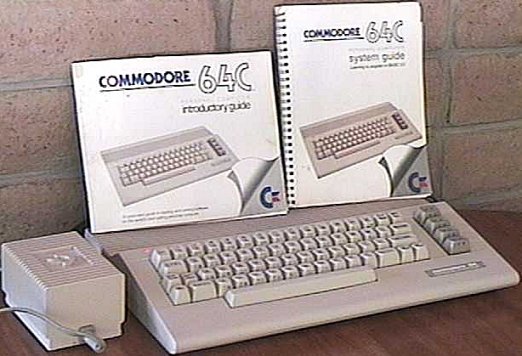
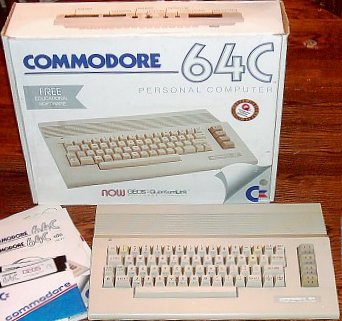
In late 1985-86, Commodore repackaged its masterpiece
C64 in a sleek new case
design, making it look a little more like their new Commodore 128.
Along with the new look came a new motherboard. Early C64c computers had a later model C64 board.
By 1987, however, they came with the new (and less expensive) 'E' boards. Fewer ROM
chips and less expensive versions of the SID (8580) were just a few of the "improvements" (there is still
much dispute as to whether the new SID is really an upgrade).
All versions of the C64C came stock with a brand new GUI operating system from Berkely Softworks
called GEOS.
 In Australia, third party companies were scrambling to beat Commodore to the punch. They
released their own "upgrade" cases, allowing owners of existing C64s to put their motherboards and
keyboards in the sleek new cases.
In Australia, third party companies were scrambling to beat Commodore to the punch. They
released their own "upgrade" cases, allowing owners of existing C64s to put their motherboards and
keyboards in the sleek new cases.
Statistics and features:
CPU: MOS 6510 or CSG 8500
- 8500 is 6510 compatible
- 1 Mhz clock speed.
RAM: 64 kilobytes
ROM: 20 kilobytes
 Video: MOS 8565 "VIC-II"
- 320 x 200 Hi-Resolution
- 40 columns text
- Palette of 16 colors.
Sound: MOS 6581 or CSG 8580 "SID"
- 3 voice stereo synthesizer/digital sound capabilities
 Ports: MOS 6526 CIA x2
- 2 Joystick/Mouse ports
- Round female DIN CBM Serial port
- Male edge-connector CBM Datasette port
- Male edge-connector parallel programmable "User" port
- Round DIN CBM Monitor port
- RCA-Style RF Audio/Video port
- Female edge-connector C64 expansion port
- Power switch
 Keyboard: Full-sized 62 key QWERTY
- 8 programmable function keys
- 4 direction 2-key cursor-pad
Resources:
Personal Note:
This line of computers I purchased only for their collectibility,
although I do think the new case design is nice. I had many friends
with this model when I was younger, and was always impressed by the
feel. My C64c was obtained from a local Austin Good Will Computerworks
while the Australian C64 and the C64-II (German) came from an
eBay auction, and the embossed logo case
revision from AmiBay.
Click here to return to the main pictures page
If you find anything in here you have questions or comments about, feel
free to leave me email right here.
To return to my home page, click here.
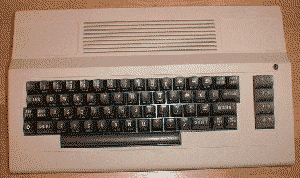 In Australia, third party companies were scrambling to beat Commodore to the punch. They
released their own "upgrade" cases, allowing owners of existing C64s to put their motherboards and
keyboards in the sleek new cases.
In Australia, third party companies were scrambling to beat Commodore to the punch. They
released their own "upgrade" cases, allowing owners of existing C64s to put their motherboards and
keyboards in the sleek new cases.